
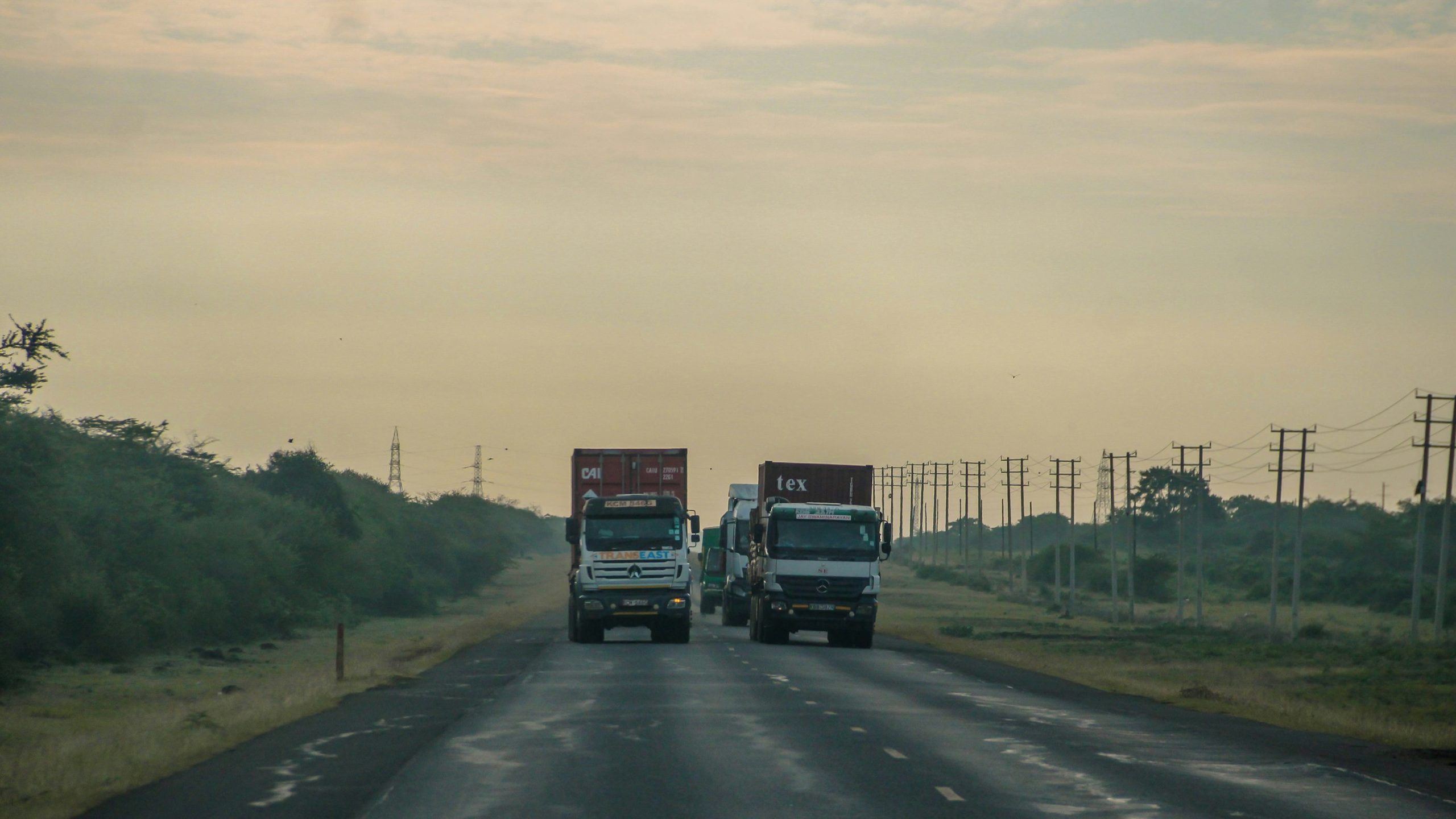
The AfCFTA has done much of its paperwork. Tariff schedules are lodged, most rules of origin are agreed, and the Guided Trade Initiative has shown that preferential shipments can clear. None of that moves a container from Tema to Lagos any faster. In our corridor work, the tariff is rarely what kills a deal. Time is.
Africa has dozens of designated corridors. Three, in our view, will decide whether the agreement is judged a success by the end of its first decade: one because it already carries the most intra-African trade, one because it is the most reformed, and one because it tests whether infrastructure built for exports can carry anything else. We have left out Dakar-Bamako, which matters a great deal to us in Dakar, only because its future now turns on security rather than trade policy.
Abidjan-Lagos: the busiest, and the most fragmented
The coastal corridor runs a little over 1,000 km through Côte d’Ivoire, Ghana, Togo, Benin and Nigeria, linking five of the region’s main ports and several of its largest consumer markets. It carries a large share of West Africa’s formal trade and a great deal of informal trade besides. It also crosses four land borders, each with its own procedures, and a long succession of police, gendarmerie and customs checkpoints in between.
Distance is not the problem here. Stopping is. On the routes we have tracked for clients, a truck can spend longer standing still at Seme-Kraké and the checkpoints either side than it spends moving between Abidjan and Accra. ECOWAS rules already allow approved goods to cross free of duty under the trade liberalisation scheme, yet drivers are still asked for documents, escorts and payments the rules do not require. Nigeria’s closure of its land borders from 2019 to 2020 is a reminder that political risk on this corridor is real.
The planned Abidjan-Lagos highway, a dual carriageway being prepared by the five governments with development partners, will help. A new road with the same checkpoints, however, will produce faster trips to the same queues. What would change things is joint border posts that genuinely work as one stop, a regional transit guarantee so that bonds are not lodged again at every frontier, and an enforced cap on roadside controls. Those are decisions for ministers, and they cost far less than the road.
The Northern Corridor: proof that the paperwork can work
Mombasa to Kampala to Kigali, with branches into South Sudan, eastern DRC and Burundi, is the route on which landlocked East Africa depends. It is also where governments have done most to remove administrative friction. The single customs territory agreed between Kenya, Uganda and Rwanda lets goods be declared once and cleared at destination, and electronic cargo tracking has replaced many physical escorts and checks. One-stop border posts at Malaba and Busia have taken the worst out of queues we used to see stretch for kilometres.
The constraints now are physical. Kenya’s standard gauge railway runs inland from Mombasa to Naivasha; work to extend it towards the Ugandan border began only this year, and Uganda is building its own line from Malaba to Kampala. Until both are finished, most cargo for Kampala and Kigali completes the trip by road, through weighbridges where axle-load limits are harmonised in East African Community law but still enforced unevenly in practice. Shippers tell us the variation is often harder to plan around than the limits themselves.
What would change things is finishing the rail link to the border and beyond, and extending the corridor’s single customs arrangements to more of the countries whose cargo uses it. The Northern Corridor has shown that administrative reform is possible. It now needs the steel.
A new road with the same checkpoints will produce faster trips to the same queues.
Lobito: can an export corridor carry trade?
The Lobito corridor runs from Angola’s Atlantic port along the Benguela railway to the border with the DRC, with a new line planned into Zambia’s Copperbelt. It has drawn unusual international attention and investment, almost all of it framed around copper and cobalt leaving the continent.
Our interest is in the return leg. Trains carrying copper to the coast run back with spare capacity, and the towns along the line in Angola, the DRC and Zambia are underserved markets for fuel, fertiliser, cement, processed food and building materials. If the operators and the three governments treat that capacity as a trade opportunity, with rail tariffs and border procedures designed for mixed cargo and smaller shippers, Lobito could become a genuine intra-African route. If they do not, it will be a very efficient conveyor to the sea, and the AfCFTA will have little to show for itself in central Africa.
The slow points are familiar: the DRC border crossings, the gap on the Zambian side until the new link is built, and the risk that access terms favour anchor mining customers. None of these is a reason for pessimism. They are reasons to settle the commercial rules now, while the system is still being designed.
What we would ask governments for
- Publish a short list of permitted roadside checks on each corridor, and penalise unofficial stops.
- Make joint border posts operate as single posts, with shared systems and matching hours.
- Adopt a regional transit guarantee so bonds are lodged once per trip.
- Price rail capacity for return cargo, and not only for anchor exports.
- Measure dwell times at every major border and publish them each quarter.
Corridors are where the AfCFTA becomes real for the people who move goods. Its first decade will be judged less by how many schedules were filed than by whether a truck leaving Abidjan, Mombasa or Lobito arrives when its owner expected it to.